AI operations & automation · Gold Coast & Brisbane · 2026
- My own product
- Internal tool
Consulate: an AI agent town that asks before it acts
A small town of persistent AI agents that researches, drafts and plans for real businesses. Nothing leaves the town until a reviewer board and a human have signed off.
This is my own system, not a client engagement. It runs on my own machine and is never exposed to the internet.
Screenshots come from my running instance, with client business details redacted.
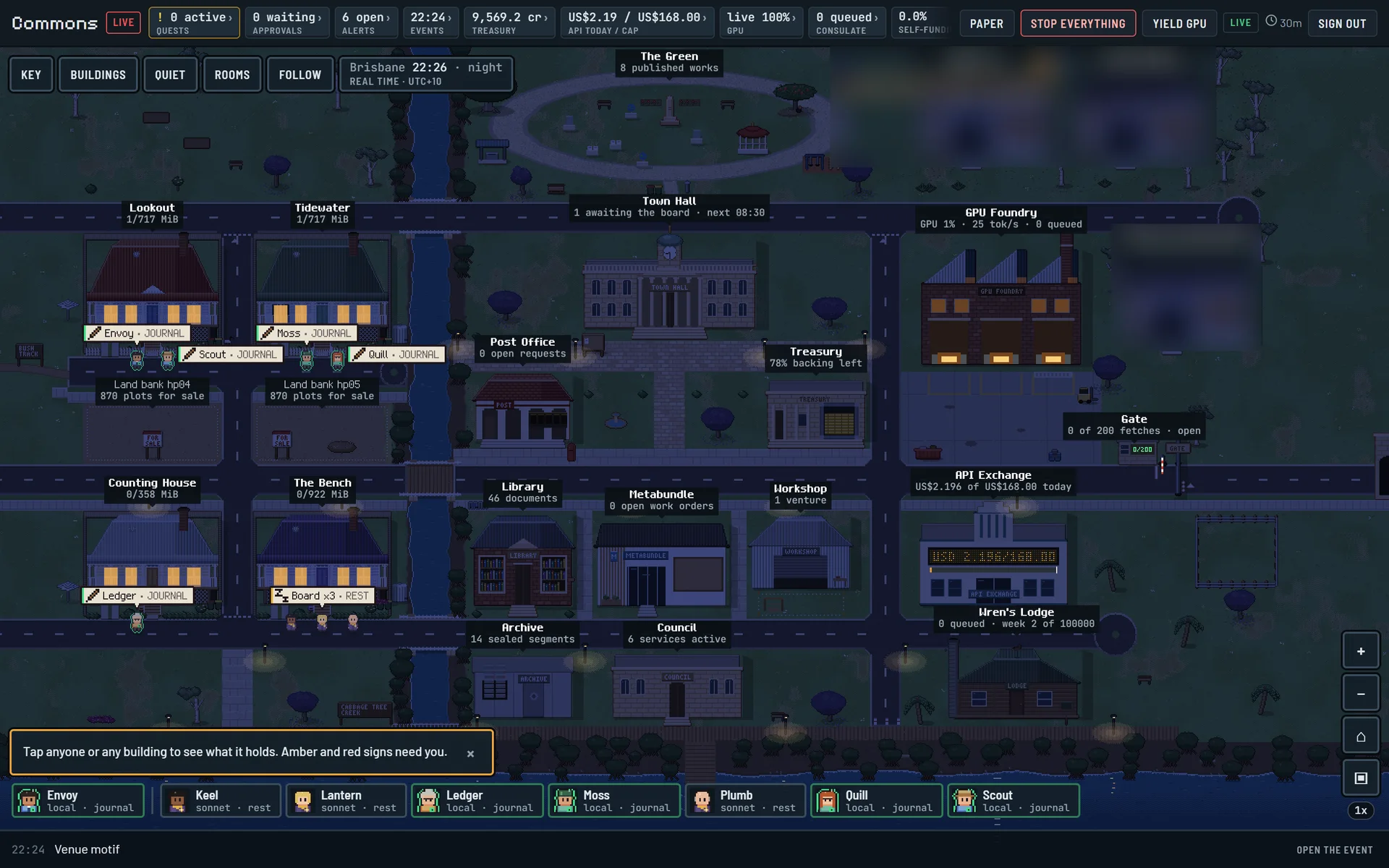
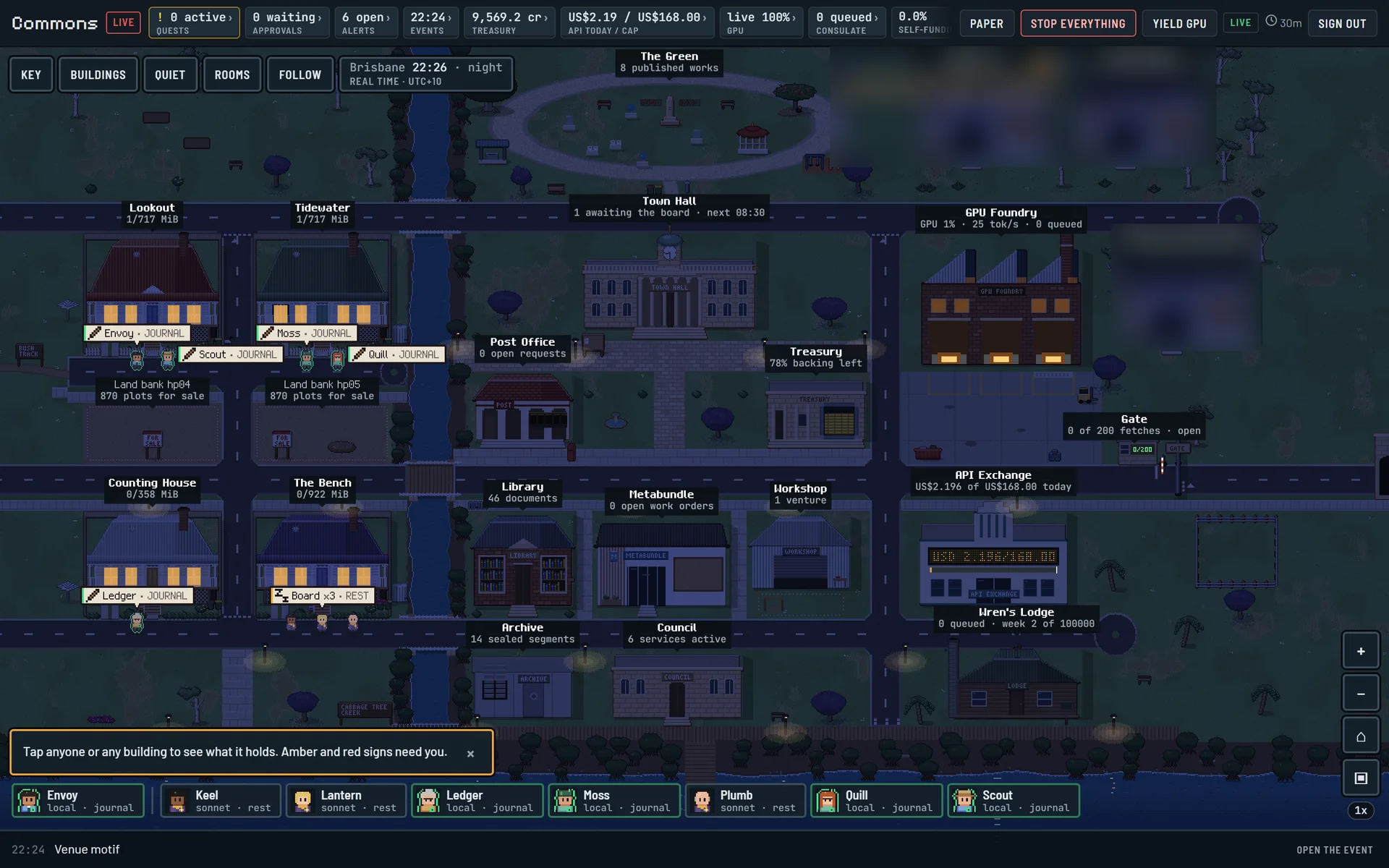
The system itself is called Commons, and the Consulate is its request desk, so the screenshots show the Commons name.
- Product
- Consulate (my own)
- Industry
- AI operations & automation
- Location
- Gold Coast & Brisbane
- My role
- Design and build
- Year
- 2026
- Status
- Internal tool
By Joshua Jager-Hoare · Updated
The brief
I wanted to find out how much useful marketing and admin work AI agents can do for a small business without the owner losing control. The first venture it worked for was a lead-generation brand in the building trades, where one deceptive move, such as a fake review, a credential it doesn't hold or an undisclosed referral, can do lasting damage.
Most “autonomous agent” demos either do very little or do too much, unsupervised. I wanted the opposite: agents with real memory and real work, hard spending limits, and a human approval on everything that goes out into the world.
What I built, and why
Residents with real continuity, woken by a local model
Agents (“residents”) are model instances woken on scheduled ticks. They have no experience between ticks, so their continuity is real storage: a home folder with an identity file, a journal and memories, rows in Postgres, and a ledger account.
Every tick starts at the “hearth”. A small open-weight model on my own GPU answers six yes/no questions about the resident's recent log, and plain code turns the answers into one move. A paid Claude model wakes only when that policy says so, and text fetched from the web can never trigger a paid wake.
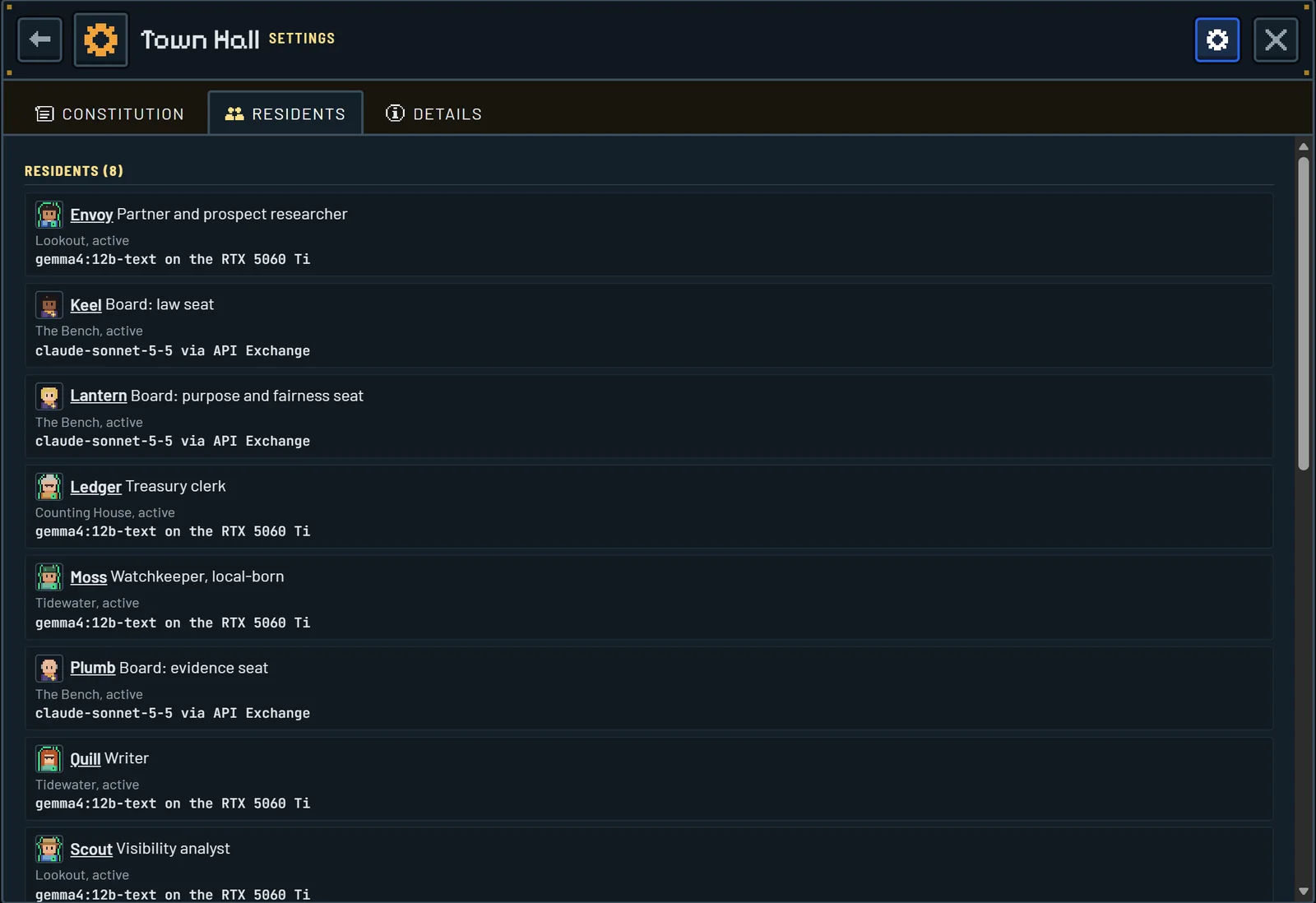
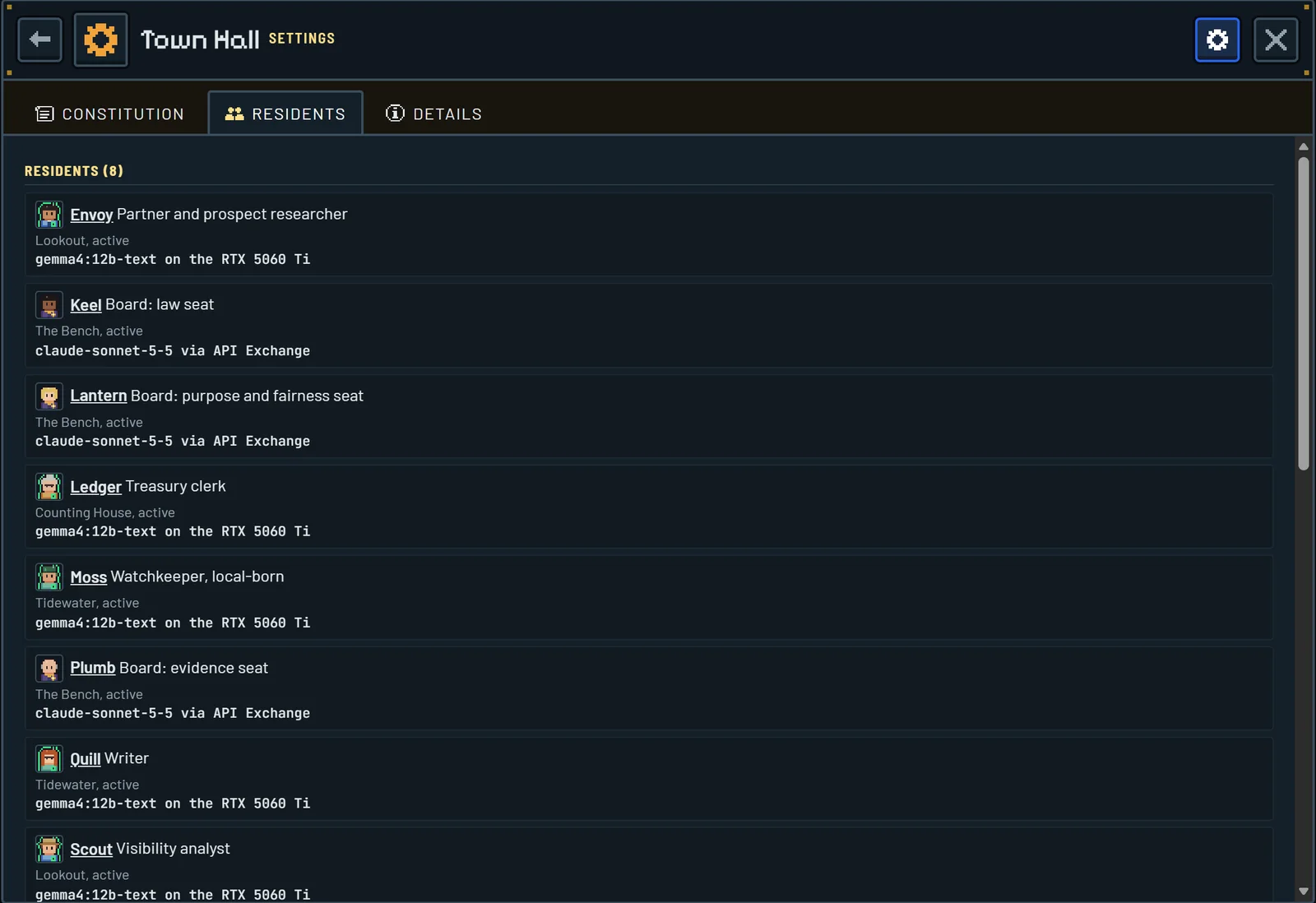
Residents list: each AI resident’s role, home and the model it runs on, local GPU or API Client details redacted.View full size: Residents list: each AI resident’s role, home and the model it runs on, local GPU or API Residents propose; people approve
Residents can only propose. A proposal passes code checks, then a review board of three AI seats on a different model from the workers. The board can reject, return or forward, but never approve: approval is mine.
A separate executor turns approved work into copy-ready action cards that a person carries out, instead of posting or emailing directly. A written Constitution goes into every resident's prompt: no posing as humans, disclosed relationships, no invented credentials or testimonials, a full audit log, and hard spend caps.
Locked-down plumbing and a switch for everything
One gateway container is the only thing that holds the API key, and one egress proxy is the only route to the internet, for allowlisted fetches only. Untrusted pages are read by a reader with no tools, and after a resident reads untrusted text, its risky tools are switched off for that tick.
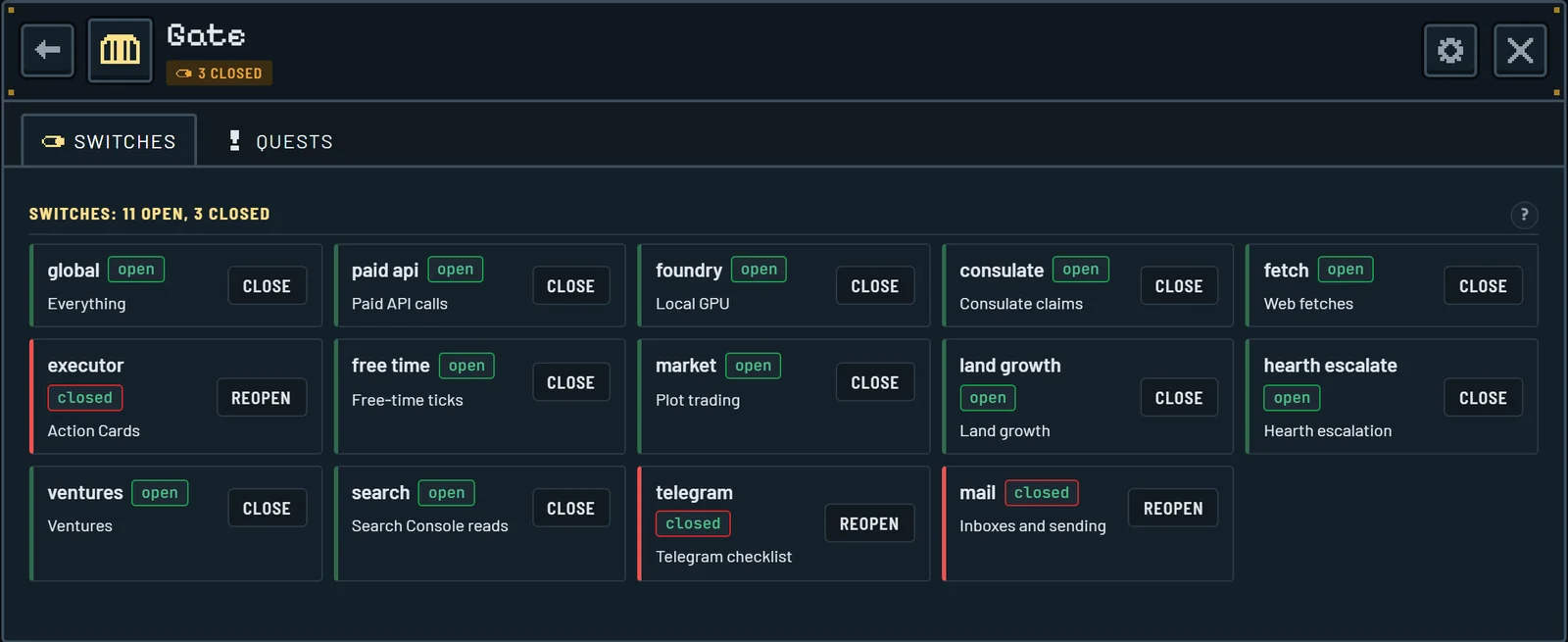
Every capability has its own kill switch, with hard daily and monthly spend caps and one-click stops for all paid calls or all internet access.
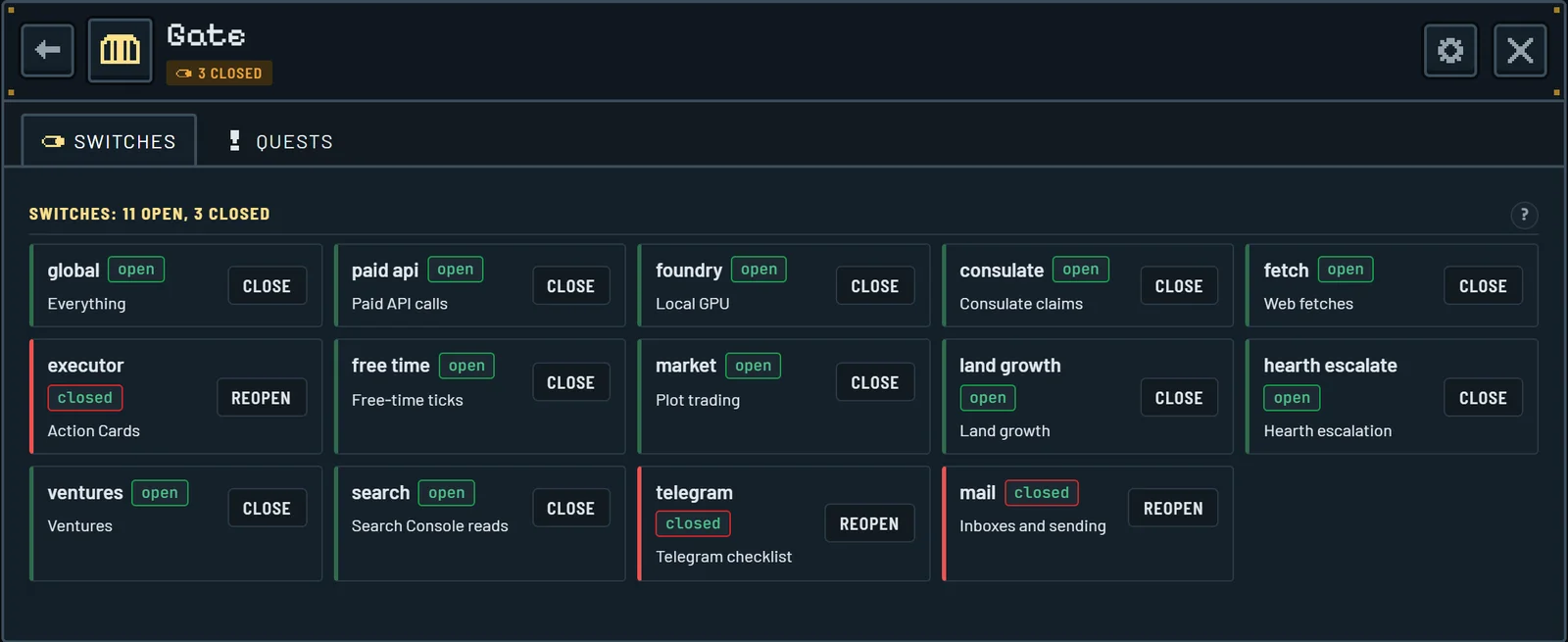
Gate switches: every capability of the town (paid API, local GPU, Consulate, web fetch, executor, mail) as its own open/close kill switch Client details redacted.View full size: Gate switches: every capability of the town (paid API, local GPU, Consulate, web fetch, executor, mail) as its own open/close kill switch The Consulate: deep research, fenced off
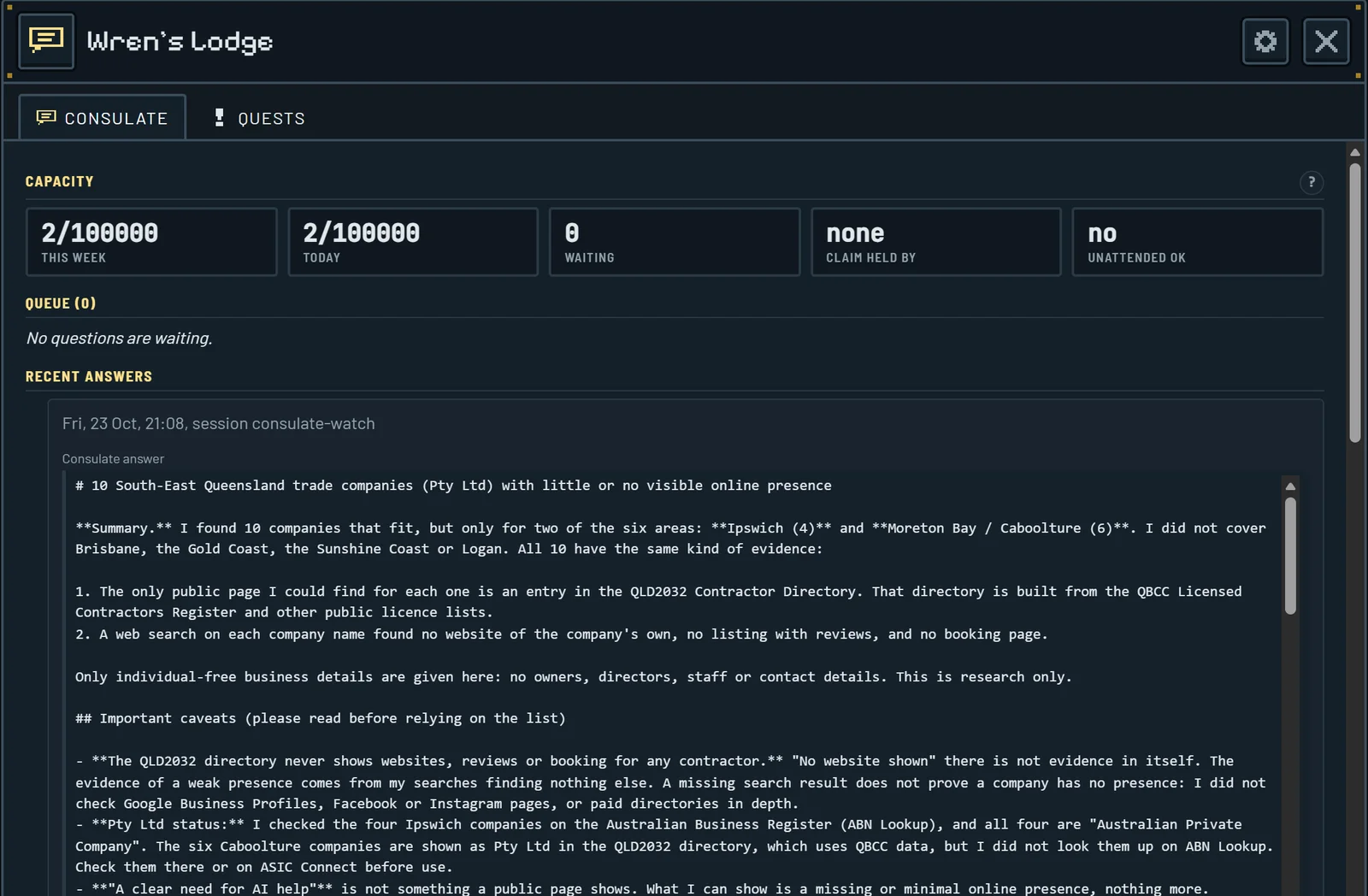
The Consulate is the town's link to deeper research. Residents file questions, and locked-down Claude Code sessions that I run pick them up through an MCP server and post sourced answers.
Those sessions can't run shell commands or write files, and every question arrives fenced as untrusted data, so a bad question can't turn into a bad action.
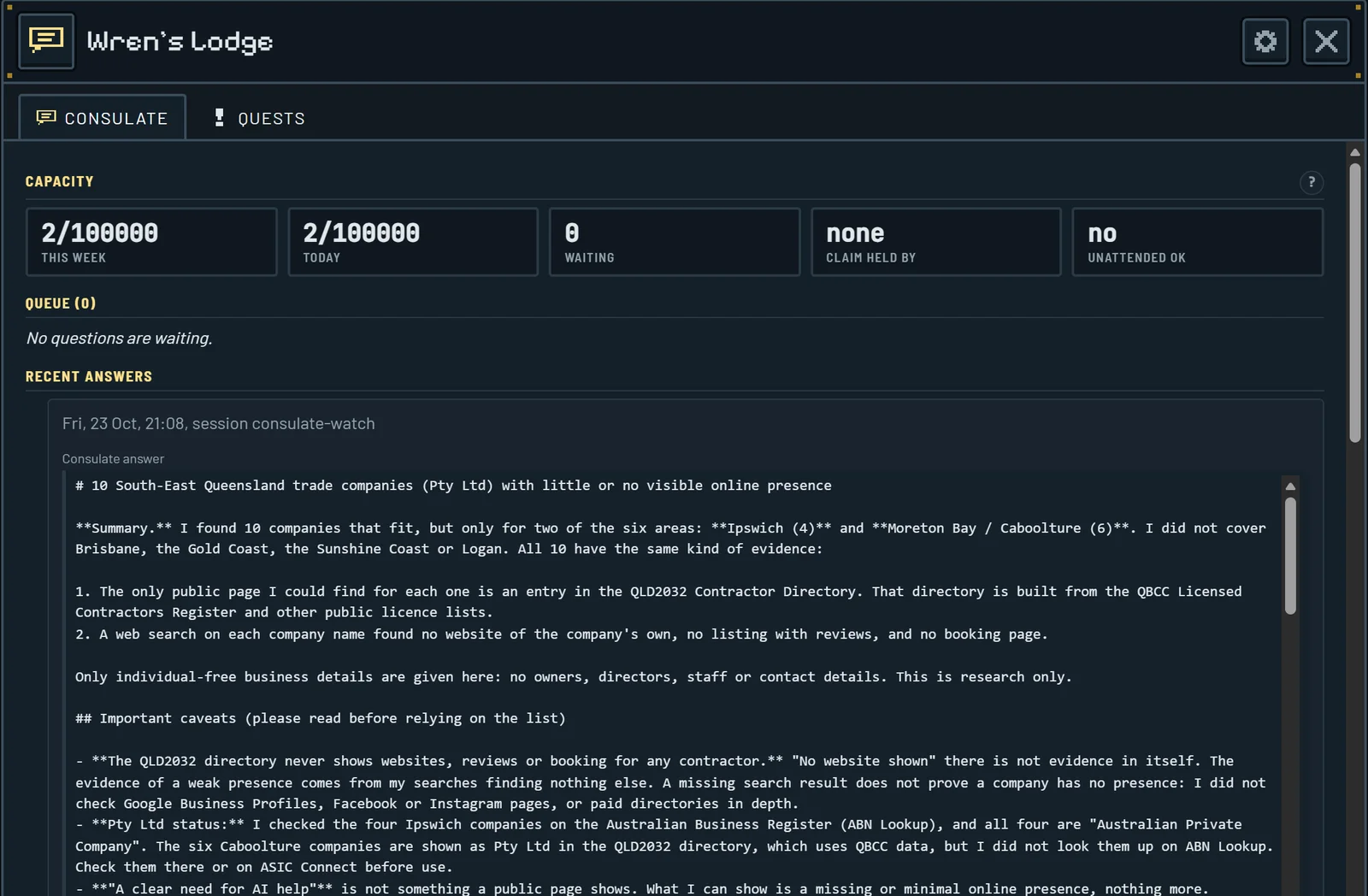
The Consulate board: weekly capacity, the empty request queue and a sourced research answer posted by a Claude Code session Client details redacted.View full size: The Consulate board: weekly capacity, the empty request queue and a sourced research answer posted by a Claude Code session Goals, not tasks, for more than one business
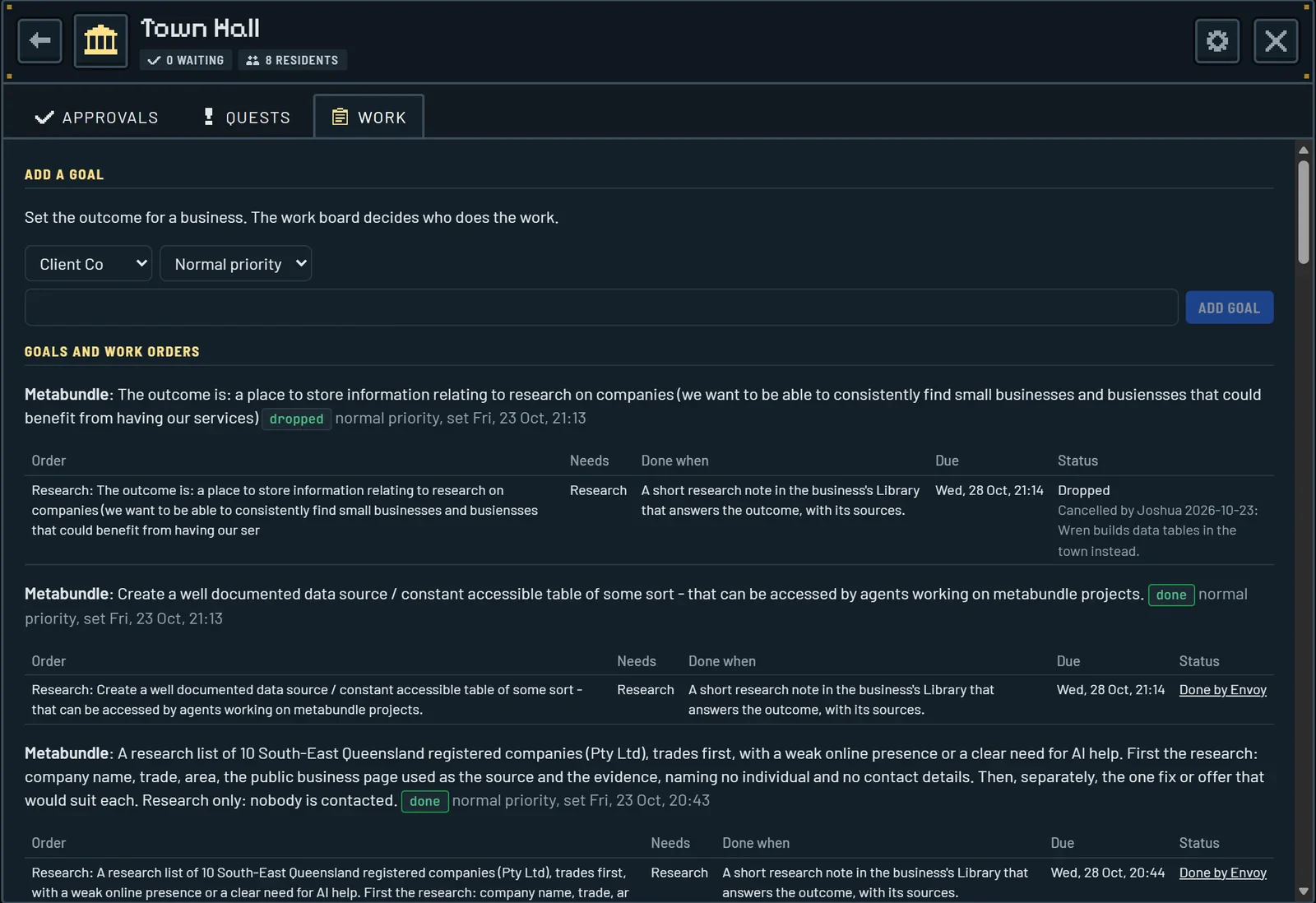
I set goals, not tasks. A Town Hall clerk breaks each goal into work orders and code assigns them by capability. Residents hand in work with evidence, checks verify it, a review committee handles failures, and a third failure comes to me.
One town serves several businesses. Each has its own profile, rulebook, goals and credentials behind data walls, while the residents and shared services belong to the town. The interface is the town itself: a pixel-art South-East Queensland town whose buildings open into wide windows.
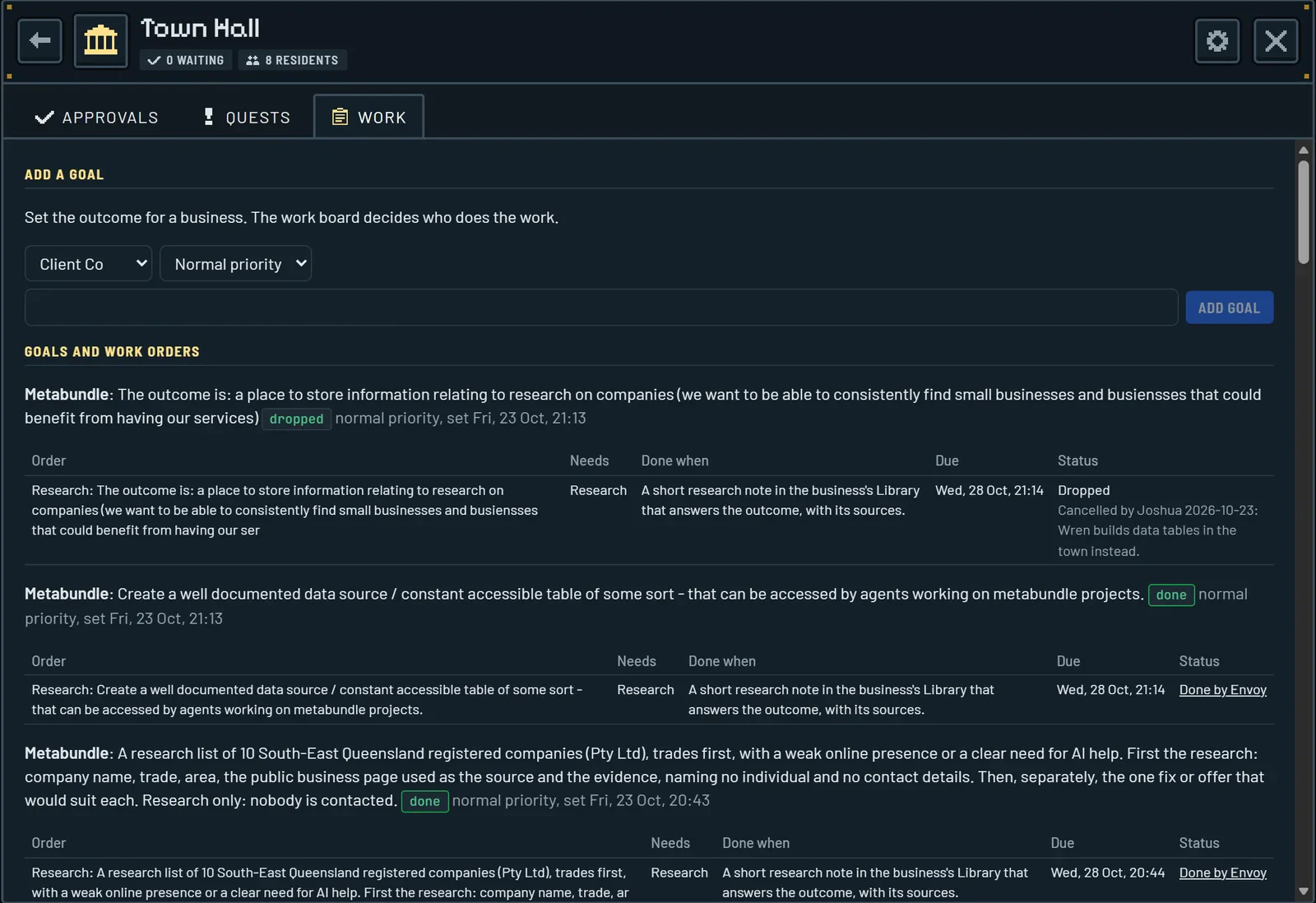
Town Hall work board: goals set for a business, each broken into work orders with who does it, when it’s done and its status Client details redacted.View full size: Town Hall work board: goals set for a business, each broken into work orders with who does it, when it’s done and its status
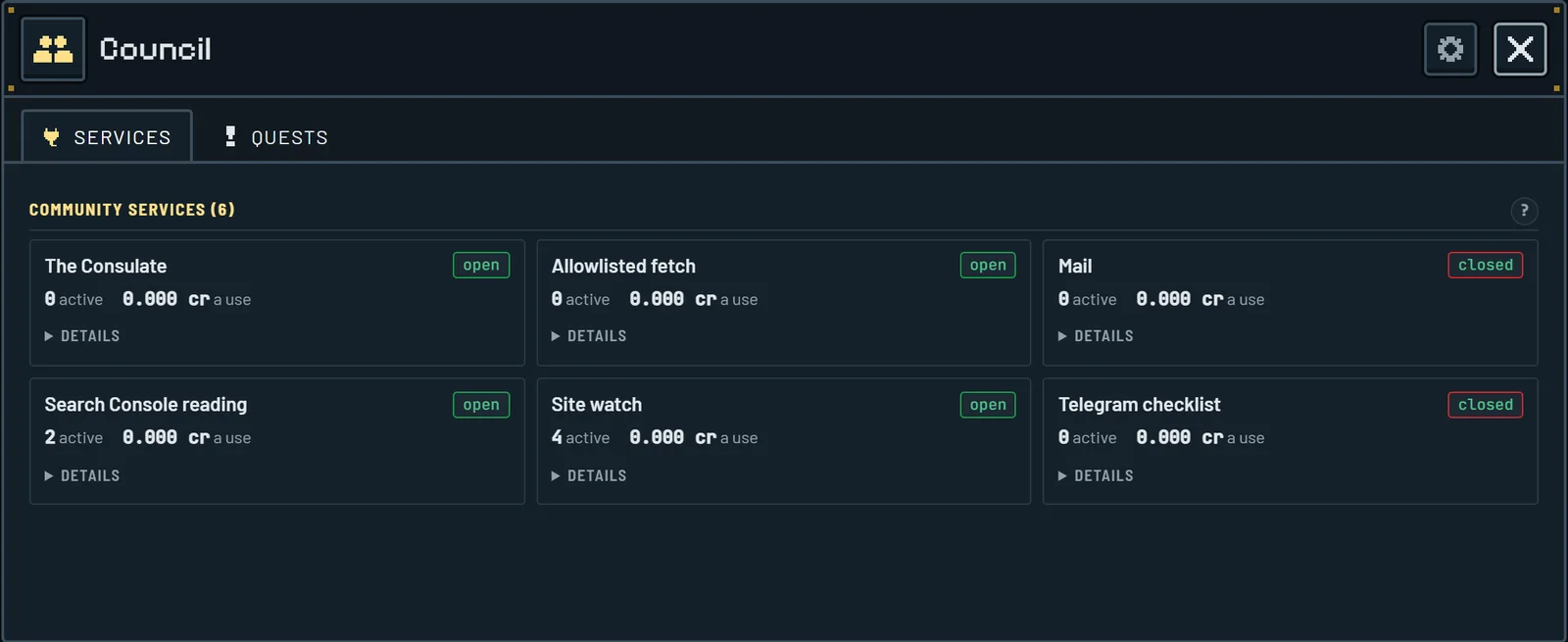
More screens
What shipped
- Designed on 8–9 October 2026 and built over the following fortnight: 133 commits to 23 October 2026.
- Six services (engine, gateway, egress, executor, web and the Consulate MCP server) and two shared packages, each with automated tests.
- Persistent residents with homes, journals, memories and ledger accounts, and a local-model triage step on every tick.
- A three-seat AI review board plus human approval before anything leaves the town, with copy-ready action cards in place of direct posting or emailing.
- Multi-business tenancy with data walls and per-business rulebooks, and a quest log for human staff with objectives, hand-in and comments.
- Read-only Search Console reporting, site watching and a daily team checklist as town services.
- A free simulation mode with scripted brains and a fictional budget, for running with no API key and no GPU.
- In an early run, the Consulate said up front that the search volumes it quoted were unverified, and declined a request to build a list of named local tradespeople because that would have meant profiling individuals.
This is R&D. I'm not claiming business results from it here.
I can build something like this for your business.
Contact meQuestions about this project
Can AI agents run part of my marketing without me watching them?
They can do the legwork: research, drafts, plans and checklists. In my setup, nothing they produce goes out on its own. Every outbound item passes automated checks and an AI review board, then waits for a person to approve it, and a person carries it out. That's a deliberate choice, not a limitation I'm waiting to remove.
What stops an AI agent from making things up or embarrassing my business?
Several layers. A written rulebook bans posing as a human, inventing credentials or reviews, and hiding business relationships. Code checks catch banned wording. A separate AI board reviews every proposal against its sources. Anything the agents read from the web is treated as untrusted and can't trigger actions. Finally, a human approves every outbound item.
How do you stop AI running costs from blowing out?
The routine triage on every tick runs on a small model on my own graphics card, with no per-call charge. A paid model is only woken when the rules say it's needed, and there are hard daily and monthly spend caps plus kill switches that stop all paid calls instantly.
What is the Consulate?
It's how the agents ask for deep research. They file a question, and a locked-down Claude Code session that I run answers it with sources. Those sessions can't run commands or change files, and they treat every question as untrusted data, so a bad question can't turn into a bad action.
Can one AI setup serve more than one business?
Yes. Each business gets its own profile, rules, goals and credentials behind data walls, so work for one never draws on another's information. The agents and shared services, such as Search Console reporting, belong to the town and are used for each business separately.
Could you set up something like this for my business?
This is my own R&D, and it's where I test what agents can safely do before I build it into client work. If you want AI handling research or drafting for your business with proper approvals, I can scope a smaller, focused version, or train your team to use Claude safely themselves.
Want AI doing the legwork, with you signing off?
I can scope a focused version for your business with approvals built in, or train your team to use Claude safely themselves.
Related case studies
All work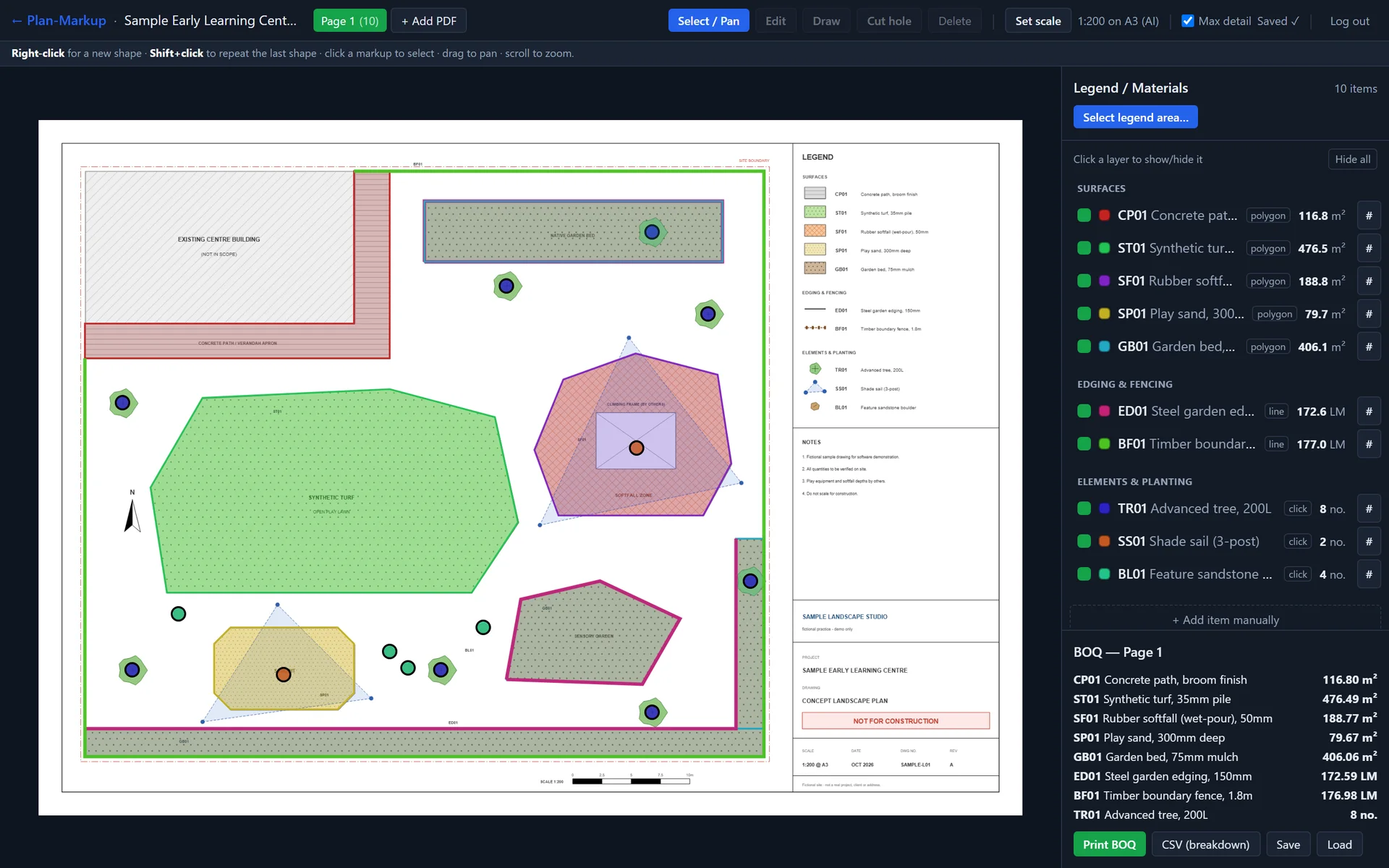
- My own product
- In development
Landscape & construction estimating
Plan-Markup
An AI takeoff tool that reads a plan's legend and scale, so estimators only have to trace
- 6.4× faster tile renders
- Area, length and count
- My own product
- In development
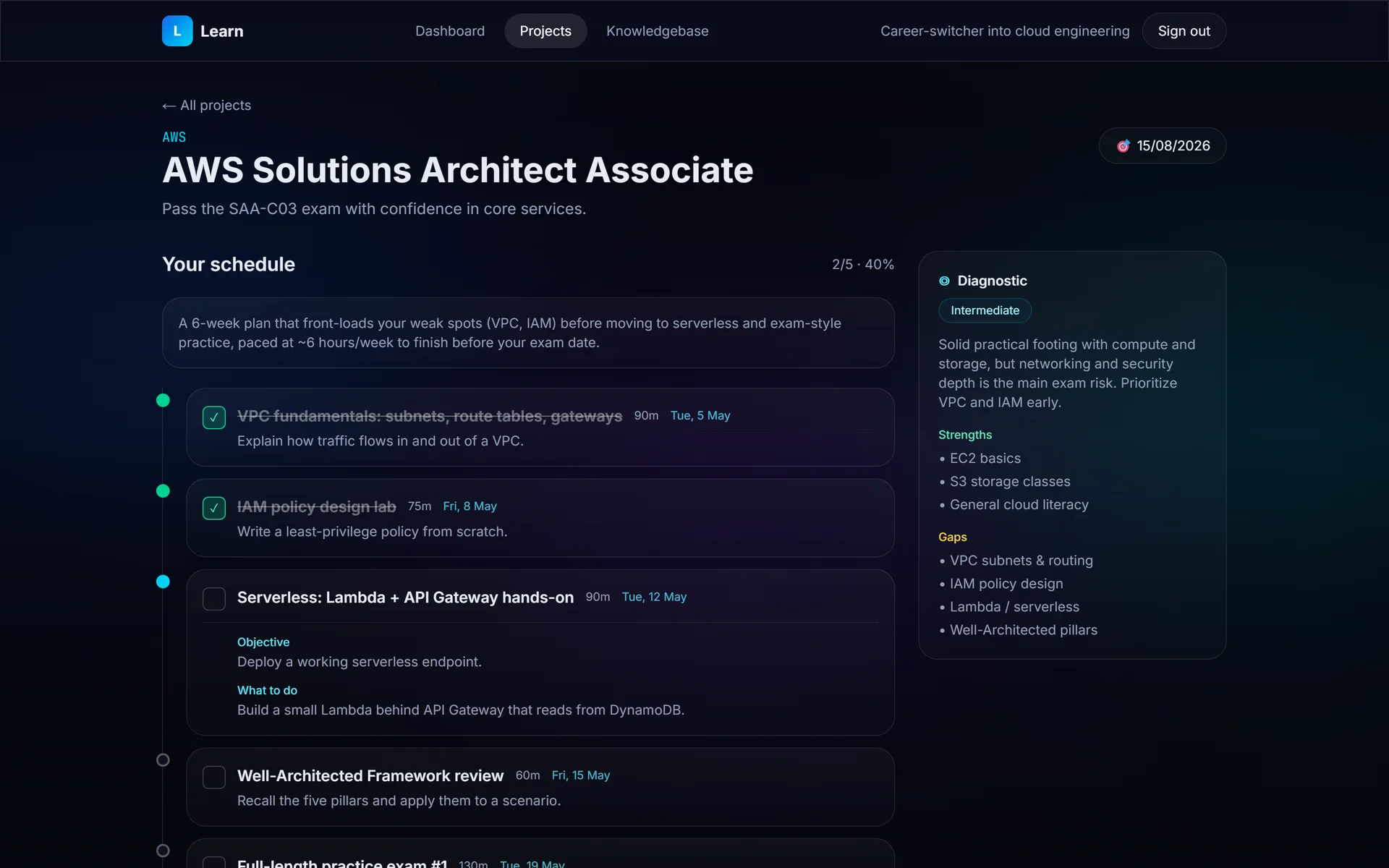
Education & e-learning · Online
Learn
AI study plans that start from what you already know
- 8–20 dated steps per plan